Today, nation states everywhere increasingly find common cause with Silicon Valley corporations in their pursuit of ‘data-driven intelligence’. Corporations and regimes are ‘both in the business of wanting to know as much as possible about people’, says Marc Owen Jones, expert on information politics in the Middle East, ‘to maximise profits, and to stay in power’. The United Arab Emirates (UAE) is a prime example of a digital superpower whose surveillance apparatus is enabled by US Big Tech companies such as Microsoft, Twitter/X and Cisco Systems.
The UAE dazzles and seduces with technological superlatives and cultural ambition, boasting a mission to Mars, an outpost of the Louvre, and an investment portfolio ranging from premier sports to a network of 60 free-trade ports around the world. In a few decades, it has transformed a barren stretch of the Arabian desert into a hypermodern oasis, establishing Dubai and Abu Dhabi as destination ‘smart cities’ where algorithmic optimisation and high-tech services aim to keep citizens ‘happy’ and attract ‘international talent’.
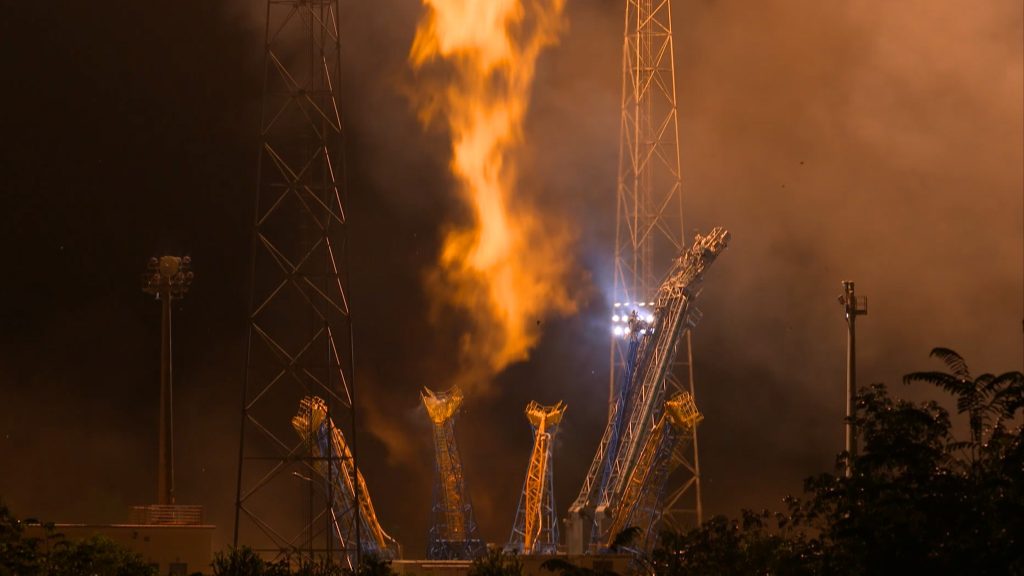
Falcon Eye 2 is a high-tech orbital spy platform built for the armed forces of the United Arab Emirates. Developed by Airbus Defence (Astrium Satellites) and Space and Thales Alenia Space, the satellite is based on France’s elite Pléiades-HR system, packing a powerful HiRI imager capable of capturing razor-sharp 70 cm resolution images across a 20 km swath—delivering near real-time intelligence from space.
But the UAE is also plainly an authoritarian monarchy that tolerates little dissent. What does its embrace of ‘smart’ technology mean for its inhabitants – for their opportunities to speak freely, for the possibility of informed debate, for their participation in the nation’s development? And how does ongoing domestic oppression relate to the carefully-cultivated nation ‘brand’, to strategic international investments, to a sometimes belligerent foreign policy?
At the heart of I Do Not Have the Courage to Stay Silent is a conversation between director Manu Luksch and Emirati engineer, free speech activist and human rights laureate Ahmed Mansoor, in which he demonstrates exemplary engagement with these questions. Together with other reformist intellectuals, he had launched an online discussion forum to foster open debate. During the Arab Spring in 2011, the Emirati government perceived this platform as a threat. Mansoor was one of the ‘UAE5’ who were brutally incarcerated without due process, and only released as a result of sustained international pressure. He emerged from prison more convinced than ever of the need to protect basic freedoms, and to not to stay silent in the face of rights abuses.
‘We live in this paradox, and it has a deep contradiction. You’re creating big cities, creating great images for the young Arab people, creating an environment that they’d love to live in – but you don’t want to give them freedom.’
– Ahmed Mansoor
In March 2017, Mansoor tweeted about a fellow Emirati human rights defender who remained in prison despite having served his sentence, warning of ‘a future precedent for prisoners of conscience.’ The same night, he was arrested for a second time and ‘disappeared’ to a high security facility, where he remains in solitary confinement to this day.
This film is not just the story of the deplorable persecution of a humane and peaceful individual by an authoritarian regime. It is a story of cyberwarfare conducted by a state against its own citizens, using million-dollar spyware and a global-scale disinformation campaign. It is the story of a father of four who alerts the world to a vulnerability affecting nearly a billion iPhone users, compelling Apple to issue an emergency security patch. I Do Not Have the Courage to Stay Silent tells the story of how public and corporate bodies in nations such as the UK, grateful for Emirati investment, turn a blind eye to its human rights abuses, and even permit the sale of technologies that enable those abuses.
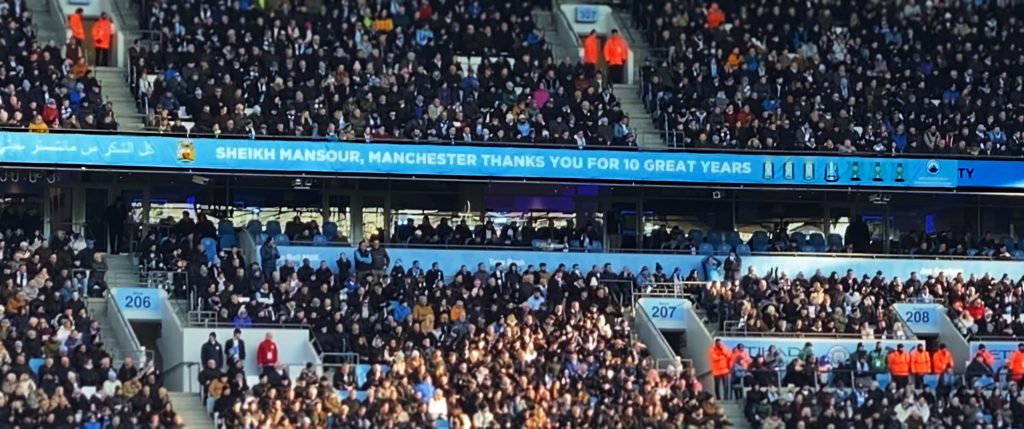
“Sheikh Mansour, Manchester Thanks You,” reads a banner that hangs permanently at Manchester City FC home stadium
This film admits the complex and ambivalent nature of the UAE’s international relationships. Emirati investment has reinvigorated the city of Manchester through investment in sports and real estate. Finance from UAE Vice President Sheikh Mansoor’s private equity company has propelled Manchester City Football Club to championship status, and his name is chanted with admiration from the terraces. But his fund has also been given access to swathes of the city’s public land at below-market rates. This is the story of a wealthy monarchy rebranding itself through cultural investment, ingratiating itself with local communities – and then extracting rents from them. It is also the story of housing activists in Manchester campaigning for affordable shelter, who recall their city’s radical past – its stand for universal suffrage, its stand against slavery – and question the complicity of their local council in property deals. It is the story of football fans who rename a city street in order to honour a prisoner of conscience, to remind the city what its current glory is predicated upon.
It would be distressing enough if the UAE were arranging its international relationships for the private gain of the ruling family, at the expense only of its own wider population. That its investment strategy negatively impacts ordinary citizens of Manchester, and those of other cities in the UK and beyond, should make its actions of interest to us all. The most concerning revelation is that the UAE has in the past used networks of mercenaries to brutally crush nascent democratic movements in the wider Middle East region. Today, there are credible allegations that it backs the Rapid Support Forces (RSF) in Sudan. When the RSF recently overran El Fasher, they slaughtered thousands and left the land stained with so much blood that it was visible in satellite imagery. This film confronts the UAE’s artful use of trade deals, nation-branding and sports-washing, and asks – is this enough to protect it from criticism of its more ruthless international ventures?
Above all, this is a film about how one individual’s courage to speak up can galvanise action across different communities. It tells the story of a fellow prisoner who discovers Mansoor in critical condition and takes immense personal risks to inform the world of his plight. It tells of accountants and journalists who forensically investigate the networks that bind the UAE to the West. Of activists who use legal instruments to hold the powerful to account. And of a former US spy who blows the whistle on the Emirati domestic surveillance program.
I Do Not Have the Courage to Stay Silent is a reminder that, in an increasingly imbalanced and unpredictable world in which liberal democracies fail to challenge autocracies and tech corporations, individuals can stand up effectively to bring about change. It is a reminder, too, that despite the UAE’s powerful apparatus of surveillance and coercion, its efforts to crush dissent are far from realised. The film asks of its viewers – if Ahmed Mansoor can transcend the walls of his confinement to inspire and bear witness, what can you do with your freedom?